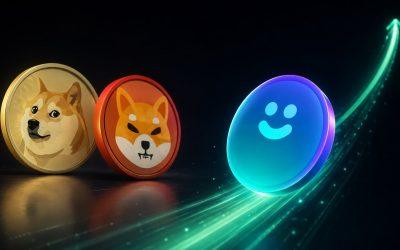
Dogecoin is a decentralized, open-source cryptocurrency that operates on its own blockchain. The native unit is called DOGE. Unlike tokens that exist on other networks such as Ethereum, Dogecoin maintains an independent ledger secured by proof-of-work mining.
The project began as a humorous response to the cryptocurrency boom of 2013. Its branding drew directly from the Doge meme, which featured a Shiba Inu dog (named Kabosu) with overlaid Comic Sans captions such as “much wow” and “so amaze.” The visual identity and playful tone helped the project stand out immediately.
Technically, Dogecoin uses the Scrypt hashing algorithm, the same family of algorithm used by Litecoin. Target block time is approximately one minute, which is faster than Bitcoin’s roughly ten-minute interval. This design choice supports quicker transaction confirmations for everyday use cases such as tipping or small transfers. Transaction fees on the network have historically remained low.
Dogecoin is merge-mined with Litecoin through Auxiliary Proof-of-Work (AuxPoW). This arrangement allows Litecoin miners to secure the Dogecoin network at relatively low additional cost, contributing to network security without requiring a completely separate mining industry.
The network has no hard maximum supply. After an early period of declining rewards, the protocol settled on a fixed subsidy of 10,000 DOGE per block. With blocks produced roughly once per minute, this results in approximately 5.26 billion new DOGE entering circulation each year. Because the absolute issuance is fixed while the total supply grows, the percentage inflation rate declines over time.
Dogecoin is commonly classified as a meme coin because of its cultural origins and community-driven identity. At the same time, it functions as a general-purpose cryptocurrency that can be transferred peer-to-peer, held in wallets, traded on exchanges, and, in limited cases, used for payments.
In 2026 Dogecoin continues to occupy a distinctive position. It is one of the longest-running and most widely recognized assets in the meme-coin category, while also maintaining a functioning proof-of-work network and deep liquidity across major trading venues.
The Dogecoin Foundation, a nonprofit organization, supports ecosystem development, education, and certain infrastructure efforts. Dogecoin Core, the primary reference implementation of the protocol, continues to receive maintenance and security updates from volunteer and Foundation-supported developers. Recent activity has included security-focused releases and ongoing work on node software, wallet libraries such as libdogecoin, and related tooling.
On the payments side, Dogecoin sees use through payment processors and selected merchants. Integrations allow some retailers and service providers to accept DOGE, often converting it to fiat at the point of sale so that merchants do not hold cryptocurrency exposure. Direct on-chain acceptance exists in a more limited set of cases. Speculative trading and portfolio allocation remain the primary drivers of volume.
Spot exchange-traded products linked to Dogecoin have become available in the United States. These products give certain investors a regulated vehicle for exposure without directly holding the cryptocurrency. Assets under management in these products have been modest compared with Bitcoin and Ether ETFs.
Dogecoin’s role in 2026 is therefore multi-layered: a cultural meme asset, a liquid trading instrument, a payments rail with selective acceptance, and a network that continues to receive development attention. Its longevity distinguishes it from the large majority of newer meme tokens that appear and disappear within short timeframes.
Dogecoin was created in December 2013. Software engineer Billy Markus (working under the pseudonym Shibetoshi Nakamoto) and Adobe product manager Jackson Palmer launched the project after discussing the idea of a fun, less serious cryptocurrency. Palmer registered the domain and contributed branding; Markus adapted the codebase.
The project forked from Luckycoin, which itself was based on Litecoin. The choice of Scrypt and the decision to lean into the then-viral Doge meme gave Dogecoin an immediate cultural identity. The network launched without a premine or initial coin offering. All coins have been issued through mining.
Early community activity set a distinctive tone. Holders organized fundraising campaigns, including support for the Jamaican bobsled team’s appearance at the 2014 Winter Olympics and clean-water projects. These efforts reinforced a generous, playful culture that contrasted with more speculative corners of the market.
Dogecoin experienced several distinct market cycles. It saw attention during the 2017–2018 cryptocurrency boom, a major surge in 2021 driven in part by social-media visibility and high-profile commentary, and subsequent periods of both strength and consolidation. Throughout these cycles the underlying network continued to operate.
Development has been more conservative than on some experimental chains. The protocol has prioritized stability, security, and compatibility with its original design goals as a medium of exchange. The Dogecoin Foundation was established later to provide organizational support for education, development funding, and ecosystem coordination without controlling the consensus rules.
The question “when did Dogecoin come out” or “when was Dogecoin created” is answered by the December 2013 launch. The project has now operated for more than twelve years, a notable span in an industry where many tokens have short lifespans.
Dogecoin Price and Market Factors
Dogecoin’s market price is determined by supply and demand on exchanges and decentralized venues. Several recurring factors influence price discovery.
Market Sentiment
As a meme coin with strong cultural branding, DOGE is sensitive to shifts in overall risk appetite and internet attention. Positive or negative social-media narratives can amplify moves in either direction.
Meme and Cultural Identity
The branding draws directly from a widely recognized meme format. This cultural reference has helped the project remain identifiable within the cat-themed segment of Solana meme tokens.
Blockchain and Ecosystem
POPCAT lives on Solana. Public information indicates a fixed supply structure with a large portion of tokens historically allocated to liquidity that was locked or burned. The project is primarily meme-oriented rather than a multi-product protocol.
Community
Discussion appears on social platforms associated with Solana meme activity. Engagement levels vary with broader market conditions.
Market Relevance
Popcat has been one of the more consistently recognized cat-themed tokens on Solana. Liquidity and trading activity exist on major Solana venues, though volumes fluctuate.
Current Narrative
The project is generally treated as an established cultural meme token rather than a new launch. Attention tends to rise and fall with Solana meme rotations.
Risks and Factors to Watch
As with other meme tokens, liquidity can vary, and price movements are sensitive to sentiment. Holder distribution and ongoing community activity are relevant monitoring points.
Bitcoin and Broader Crypto Cycles
Dogecoin has historically shown correlation with Bitcoin and the wider cryptocurrency market. Periods of strength in large-cap assets often coincide with increased interest in more speculative names, while risk-off environments tend to pressure DOGE along with other altcoins.
Trading Activity and Liquidity
Deep liquidity across major centralized exchanges supports relatively efficient price discovery compared with thinner meme tokens. High trading volume can both reflect and reinforce interest, although volume alone does not indicate sustainable demand.
Community Interest
An engaged holder base and ongoing cultural relevance contribute to baseline demand. Community-driven initiatives, tipping culture, and social visibility help maintain awareness even during quieter market periods.
Adoption and Use
Actual transactional use for payments or tipping can support organic demand, though the scale of such activity remains modest relative to speculative volume. Expansion or contraction of merchant acceptance and payment-processor support can influence perceptions of utility.
Broader Conditions
Macroeconomic factors, regulatory developments, liquidity conditions across digital-asset markets, and competing narratives within the meme-coin sector all play roles. Inflationary issuance means that new supply continuously enters the market, which can exert gradual downward pressure on price unless matched by rising demand.
This article does not provide a current DOGE price or market-capitalization figure, as those values change continuously. Readers seeking live data should consult established market-data providers.
Dogecoin VS Dogecoin Stock
Dogecoin is a cryptocurrency. It is not a stock.
A stock (or share) represents fractional ownership in a corporation. Shareholders typically have claims on residual profits, voting rights in corporate governance, and residual assets in liquidation, subject to the company’s legal structure and applicable securities laws.
DOGE does not represent ownership in the Dogecoin Foundation, Dogecoin Core developers, or any company. Holding DOGE confers the ability to transfer the tokens on the Dogecoin network, to trade them, and to use them where accepted. It does not confer equity, dividends, or control over development decisions.
Searches for “dogecoin stock,” “dogecoin stock price,” or “doge coin stock” often reflect users seeking the price of DOGE itself or looking for a traditional equity vehicle related to the project. There is no official “Dogecoin stock” that equals ownership of the cryptocurrency network. Separately, certain publicly traded companies or investment products may hold DOGE or offer exposure to it; those are distinct securities and should be evaluated on their own merits.
Confusing cryptocurrency tokens with corporate equity can lead to incorrect expectations about rights, governance, and risk. DOGE is a digital asset whose value is set by market participants; it is not a claim on a company’s balance sheet.
Buying Dogecoin generally involves using a cryptocurrency exchange or brokerage platform that supports DOGE trading pairs.
Common steps include creating an account, completing any required identity verification, depositing fiat currency or another cryptocurrency, and placing an order for DOGE. Trading pairs may include DOGE/USD, DOGE/USDT, or DOGE paired with Bitcoin or other assets, depending on the venue.
Fees, spreads, and available order types vary by platform. Liquidity is typically deeper on larger centralized exchanges. After purchase, users may leave DOGE on the exchange or withdraw it to a personal wallet. Self-custody requires managing private keys or seed phrases securely; loss of these credentials usually means permanent loss of the funds.
Security considerations include enabling two-factor authentication, verifying withdrawal addresses carefully, and being alert to phishing attempts. Regulatory requirements differ by jurisdiction and may affect which platforms are available and what verification is needed.
This information is educational only. It does not constitute a recommendation to buy Dogecoin, advice on position size, or guidance on any specific platform. Readers should conduct their own research and consider their risk tolerance.
Why Dogecoin Remains Popular
Several factors help explain Dogecoin’s continued visibility more than a decade after launch.
Brand recognition is high. The Doge meme and the Shiba Inu imagery remain widely understood, giving DOGE an immediate cultural shorthand that many newer tokens lack. Longevity itself builds familiarity; market participants who entered crypto in earlier cycles often already know the asset.
The community has maintained a distinctive identity centered on humor, accessibility, and occasional charitable activity. Liquidity across major exchanges makes DOGE relatively easy to trade compared with thinner alternative meme coins. Exchange availability is broad, lowering friction for new participants.
Historical market cycles have repeatedly brought Dogecoin back into public conversation, reinforcing its status as a reference point within the meme-coin category. Development continuity, even if conservative, signals that the network is maintained rather than abandoned.
None of these factors guarantees future performance. They do help account for why DOGE continues to attract attention when many contemporaneous projects have faded.
Token prices in the cat meme category are influenced by the same core forces that affect most meme coins.
Price volatility
Price volatility is high. Large percentage moves in both directions are common and can occur rapidly. The inflationary supply schedule means new DOGE continually enters circulation, which can dilute existing holdings if demand does not grow correspondingly.
Market sentiment
Market sentiment drives much of the trading activity. Shifts in social attention, broader risk appetite, or competing narratives can lead to sharp reversals. Liquidity, while deeper than for most meme tokens, can still thin during stress, increasing slippage.
Regulatory
Regulatory uncertainty affects the entire cryptocurrency sector. Changes in classification, reporting requirements, or exchange rules could influence accessibility or demand. Network and software risks exist, as with any blockchain, although the long operational history provides a track record of resilience.
Wallet And Exchange
Wallet and exchange risks include loss of private keys, platform failures, hacks, or withdrawal restrictions. Competition from newer meme coins and other digital assets is ongoing. Broader cryptocurrency market downturns have historically pressured DOGE along with other risk assets.
What to Watch for DOGE in 2026
Several areas are relevant for those following Dogecoin through 2026.
Broader cryptocurrency market conditions and Bitcoin’s trend remain important contextual factors. Meme-coin sector sentiment and rotations of attention among narrative-driven tokens can influence relative performance.
On the network side, continued Core development, security releases, and any progress on proposed improvements are worth monitoring. Payment-related integrations, merchant tools, and processor support provide signals about real-world transactional use. ETF product flows and assets under management offer a window into regulated demand.
Community activity, social visibility, and liquidity metrics across major venues help gauge ongoing interest. Regulatory developments that affect cryptocurrencies or specific product types may also shape the environment.
None of these factors produces a guaranteed outcome. They represent observable dimensions that market participants commonly track when assessing Dogecoin’s position and trajectory.
What is Dogecoin?
Dogecoin is a decentralized cryptocurrency that launched in December 2013. It operates on its own proof-of-work blockchain and uses the ticker DOGE.
What are Dogecoins?
Dogecoins are the individual units of the Dogecoin cryptocurrency. The total circulating supply grows over time through mining rewards.
When was Dogecoin created?
Dogecoin was created and launched in December 2013 by Billy Markus and Jackson Palmer.
When did Dogecoin come out?
The Dogecoin network went live in December 2013.
What is Dogecoin USD?
Dogecoin USD typically refers to the market price of one DOGE expressed in United States dollars. The price fluctuates continuously based on trading activity.
Is Dogecoin a stock?
No. Dogecoin is a cryptocurrency. It does not represent ownership in a company or entitle holders to equity rights.
What is the Dogecoin stock price?
There is no traditional stock price for Dogecoin itself because DOGE is not equity. Searches for this phrase usually seek the cryptocurrency market price of DOGE or information about related investment products.
How do I buy Dogecoin?
Dogecoin can be purchased on cryptocurrency exchanges that list DOGE trading pairs. The process generally involves account creation, verification where required, depositing funds, and placing an order. Withdrawal to a personal wallet is optional.
How do I buy Dogecoins?
The same process used to buy Dogecoin applies. Use a reputable platform that supports DOGE, complete any necessary steps, and execute a trade.
What is DOGE used for?
DOGE can be transferred peer-to-peer, used for tipping, traded on exchanges, held as a speculative asset, and, in limited cases, spent with merchants that accept it directly or through payment processors.
Is Dogecoin still relevant in 2026?
Dogecoin continues to maintain brand recognition, exchange liquidity, an operating network, and a presence in both meme-coin culture and broader cryptocurrency discussions.
What affects the Dogecoin price?
Price is influenced by overall crypto market conditions, Bitcoin trends, community and social attention, trading liquidity, adoption developments, macroeconomic factors, and the continuous issuance of new supply.
Conclusion
Dogecoin began in December 2013 as a lighthearted experiment that fused internet meme culture with blockchain technology. More than twelve years later it remains a functioning proof-of-work cryptocurrency with its own independent network, an inflationary but transparent supply schedule, and one of the strongest brand identities in the meme-coin category.
Its technical foundation (Scrypt proof-of-work, approximately one-minute blocks, merge-mining with Litecoin, and a fixed 10,000 DOGE block reward) has proven durable. Development continues through volunteer and Foundation-supported efforts. Spot ETFs have added a regulated access channel for some investors. Selective payment acceptance exists, though speculative trading dominates volume.
Dogecoin is not a stock. Buying DOGE does not confer corporate ownership. Price is set by market participants and is subject to high volatility, sentiment shifts, and the effects of ongoing issuance. Risks are material and should be understood clearly.
For readers exploring Dogecoin in 2026, the most useful approach is to combine an understanding of its history and mechanics with careful attention to liquidity, security practices, and the broader market context. The network’s longevity and cultural resonance explain its continued visibility; they do not remove the uncertainties inherent in cryptocurrency markets.